
A friend of mine recruits for a GCC in Cyber City. Last month she said something I haven't stopped thinking about: "I'm not hiring AI engineers. I'm hiring accountants who aren't scared of AI."
That's it, really. That's the whole shift in one sentence.
Scroll through job postings from DLF Phase 2 or Udyog Vihar right now and you'll spot the pattern fast. A data analyst opening wanting "comfort with AI-assisted reporting." An HR listing mentioning "AI-based screening tools" almost as an afterthought. A marketing role burying "basic prompt writing" in the third bullet point, like it's no big deal. It isn't a big deal, honestly — but it's also not optional anymore.
None of these are AI jobs. They're the same jobs Gurgaon has always had, with one new expectation stitched quietly into the fine print.
If you have already been searching for an AI course in Gurgaon on Google this year, you are unlikely to want to become a data scientist. You don't want to be the last person in your team to master the shortcut. It's a perfectly legal desire. This is the kind of thing you should spend your time on.
Why AI Skills Matter for Gurgaon's Job Market
Here's the part nobody puts in the job posting itself: companies aren't really hiring for AI. They're rebuilding roles they already had, one team at a time, without making a big announcement about it.
A business analyst who used to spend three days on a report now does it in one — half the grunt work runs through an AI tool before she's even opened Excel. A support executive who once answered every ticket personally now mostly handles what the chatbot couldn't resolve on its own. Neither of their job titles changed on paper. What they actually do all day.
That's the whole point of this piece. AI skills aren't a separate track you bolt onto your career. They live inside whatever you're already doing. You don't need to pivot into tech. You need to stop being the slowest link in your own team.
Prompt Engineering
I'll say this upfront — "prompt engineering" is a fairly silly name for something this simple. It just means asking for things clearly enough that you're not on your third follow-up attempt trying to get something usable.
Most first attempts are vague. "Write me a report." And vague input gets vague output, every single time, no exceptions. The fix isn't some clever trick people are hiding from you. It's context — who's this for, what tone, what to include, and just as importantly, what to leave out.
There's a content executive at a mid-sized Gurgaon agency I know who used to burn close to two hours drafting client reports by hand. Once she got into the habit of structuring her prompts properly — audience, key numbers, tone, and explicit exclusions — that same draft came down to about 20 minutes. She didn't magically get more free time out of the deal. She just started spending that extra hour and a half on the strategy work that actually pays her salary, instead of formatting bullet points.
Think of it less like typing into a search bar and more like briefing a genuinely sharp new hire who's never met your client. That's basically what you're doing.
Python for AI and Data Handling
Unpopular opinion, maybe: most beginners overthink how much Python they actually need here. You're not building a model from scratch. Mostly you're reading messy data, cleaning it up a bit, and running tools somebody else already built.
Still worth getting comfortable with — reading and cleaning data (pandas covers most of it), basic loops and conditional logic, and running pre-trained models without needing to understand every line underneath the hood.
A final-year B.Tech student applying for data internships told me nearly every listing said "Python preferred," not required — the kind of line most people skim right past. He didn't skim past it. Six weeks working on actual messy datasets, not textbook ones, and he cleared the technical screening for two internships back to back.
Machine Learning Fundamentals
Nobody's expecting you to build ML models from scratch for most roles in Gurgaon. But not understanding how they work at all? That's a real gap, because it means you can't tell when the output sitting in front of you is simply wrong.
At minimum: the difference between supervised and unsupervised learning, how training data quietly shapes what gets predicted, and — this one gets skipped a lot — where these models tend to fail in the real world versus the demo.
A retail analytics firm out in Udyog Vihar runs ML models to forecast inventory needs. The analysts who roughly understand how those forecasts get generated are the ones who catch a bad number before it becomes an ordering mistake worth real money. Everyone else just finds out after the shelves are already wrong.
AI Tools for Business Automation
This is where the payoff shows up fastest, and it's really not subtle.
|
Department |
AI Use Case |
|
HR |
Resume screening, interview scheduling |
|
Sales |
Lead scoring, follow-up email drafting |
|
Operations |
Report generation, meeting summaries |
|
Customer Support |
Chatbot handling, ticket categorization |
A logistics company out in Manesar automated its daily shipment status report with a fairly basic workflow tool, nothing fancy about it. That report used to eat 90 minutes of somebody's morning, every day, like clockwork. Now it's sitting in the team's inbox before anyone's even logged on. Nobody lost a job over it — that person just spends those 90 minutes on something that actually needs a brain attached to it.
Data Analysis and Visualization
AI output is only as good as the data underneath it. Which means the person who can actually explain that data is doing the harder job here, not the tool.
In practice that's reading a dashboard — Power BI, Tableau, or honestly just Excel most of the time — telling a real trend apart from plain noise, and explaining what you found to someone who has zero interest in the technical details.
Someone told me about an interview where a candidate got shown a sales chart with an unexplained dip and was asked to walk through it. Everyone in that room had the same AI-generated summary of the chart sitting in front of them. What made her stand out wasn't repeating that summary — it was that she added her own read on seasonal timing, something the AI's summary had missed completely.
AI in SAP and Enterprise Systems
Gurgaon has an unusually thick cluster of companies running SAP for finance, supply chain, and HR. And SAP itself has spent the last couple of years quietly folding AI features into its modules.
If you're already circling an SAP Institute in Gurgaon, or working toward an SAP Certification in Gurgaon, it's worth treating AI fundamentals as part of that same path rather than something separate you'll "get to eventually."
SAP is where the enterprise data actually lives. AI is increasingly what interprets it. The predictive features buried inside modules like demand planning already run on AI logic, whether the person using them notices or not. And a company would rather hire one consultant who understands both layers than train two people who each know half of it.
A professional I spoke with was working toward SAP FICO certification and tacked on a short AI fundamentals module almost as an afterthought — didn't think much of it at the time. At her next appraisal, she got pulled onto a process automation project. That's usually work handed to senior consultants, not someone still finishing certification.
AI Ethics and Responsible Use
This one barely shows up in course brochures, but it comes up constantly in interviews now, especially anything touching customer data or hiring decisions.
Worth knowing: how data privacy actually works in practice, not just the theory of it. How bias creeps into AI systems without anyone intending it to. And knowing when a decision genuinely needs a human to sign off, instead of an AI's best guess getting waved through.
Someone I know was interviewing for a compliance-adjacent role and got asked how she'd handle an AI screening tool that seemed to reject certain resumes at a strange rate. That's not a technical question at all, if you think about it. It's a judgment call. And more companies are testing for exactly that kind of judgment now, not just whether you can operate the tool.
Common Mistakes When Learning AI
The biggest one, by far, is chasing whatever tool is trending instead of the concepts underneath it — the tool everyone's using this year probably won't exist in three, but the logic underneath it will still apply. Close behind that is skipping hands-on practice; watching a tutorial isn't remotely the same as using something under a real deadline with a real client waiting. People also tend to ignore the business angle entirely — understanding how something works doesn't help much if you can't explain to your manager why it's worth doing. And plenty of people pick a course based purely on price, which sometimes means the curriculum hasn't been touched since 2023.
Choosing the Right Institute
Don't take the brochure on its word, go and verify a couple of things before signing up anywhere. Are there real projects or is it mainly being taught slide and theory? Is the trainers' experience from the industry or are they just academic qualifications? Does it call for placement in a certain industry or is it a general “promise”? Are the batches small enough that you'll actually get noticed? And is the content updated for how things work in 2026, not whatever was true in 2022?
Ask to see one project from a past batch before you pay anything. Five minutes of that tells you more than the entire brochure.
Getting Started
Figure out first whether you're upskilling in your current role or genuinely switching fields, because that changes what to prioritize. Pick two or three skills from this list that actually apply to your industry — not all seven, nobody needs all seven at once. Choose a format you'll realistically stick with, weekday, weekend, or self-paced, not whichever one sounds most impressive on paper. Build one real project during the course itself, not "later" when you supposedly have time, because you won't. Put it on your resume with specifics — "AI knowledge" tells a recruiter nothing, but "automated weekly reporting, cut turnaround from 90 minutes to 10" tells them everything. And practice saying it out loud before an interview using an example like the ones above. That's a different skill from just knowing the material, and it shows the moment you open your mouth.
Industry Insights
Based on publicly available hiring trends and reports out of the NCR region, roles asking for "AI familiarity alongside a core skill" seem to be growing faster than roles for pure AI specialists. That lines up with what training institutes in Gurgaon report seeing on their intake forms too — the people signing up aren't mostly IT graduates. They're finance, HR, sales, and operations professionals who can already see this coming and would rather not get caught flat-footed by it.
Where This Is Headed in 2026
A finance person who understands AI is going to beat an AI generalist who doesn't understand finance, and that gap keeps widening rather than narrowing. SAP and AI keep getting more tangled together, not less. Being able to question and double-check AI output is turning into as valuable a skill as producing it in the first place — maybe more valuable. And shorter courses that concentrate on projects are gaining the upper hand over long courses that are full of theories, particularly for those who work full time and don't have six months to kill on a course they could have finished in six weeks.
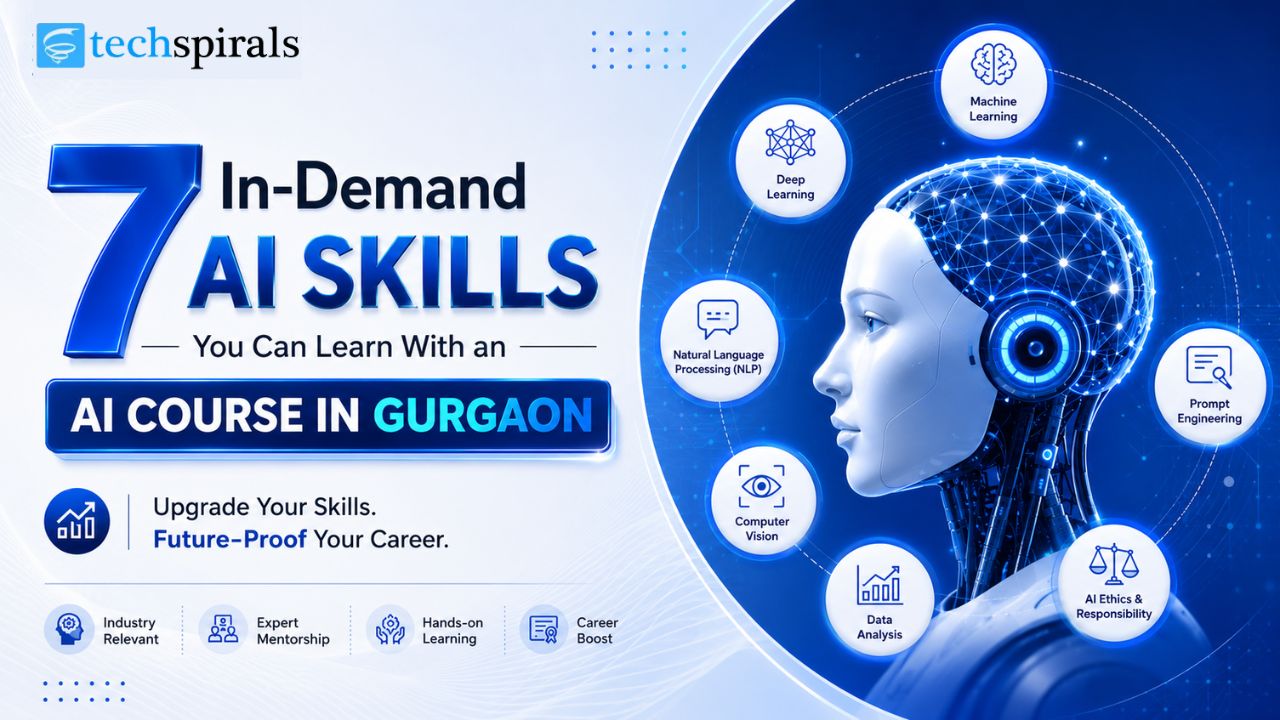
However, when you look at them all together, none of these seven skills is really about coding. They're about prompting clearly, reading the data honestly, automating the boring aspects of a job, understanding where AI fits into systems, such as SAP, and knowing when to believe what is in front of them and when not. Those who are benefiting from this change aren't leaving their professions. They're just sharpening the one they've already got.
Final Thought
AI isn't taking over careers in Gurgaon. It's rewriting the job description underneath the ones people already have. Whether you're a student chasing your first offer, a professional angling for a promotion, or someone weighing an SAP Institute in Gurgaon to round out your enterprise skills, learning practical AI is one of the more sensible bets you can make heading into 2026.
FAQs
Do I need a technical background to join an AI course in Gurgaon?
No. Most beginner-friendly courses are built for non-technical learners, with Python and technical concepts introduced gradually rather than dumped on you in week one.
How long does it take to learn these skills?
Somewhere around 6 to 12 weeks with consistent practice, though that really depends on how much time you can put in each week and which format you pick.
Is an AI course useful if I already work in SAP?
Yes, and increasingly it's a real advantage — companies are actively looking for people who understand both the enterprise system and the AI layer sitting inside it.
Which skill should freshers focus on first?
Prompt engineering and basic data analysis tend to give the fastest, most visible return, regardless of which industry you're heading into.
Are these courses only useful for IT professionals?
Not even close. Sales, HR, finance, and operations professionals are among the fastest-growing groups enrolling right now — arguably faster than IT folks.
What's the difference between an AI course and a data science course?
AI courses generally focus on applying tools practically across different roles. Data science courses go deeper into actually building models and the statistics behind them.
How do I know if an institute in Gurgaon is credible?
Real projects, trainers with actual industry experience, honest (not inflated) placement claims, and a curriculum that's demonstrably been updated for 2026 rather than recycled year after year.